
"The mood of the nation is sober. If we can take the Ayodhya judgment in our stride, we can very well pass through the Godhra judgment peacefully. I am very confident." says Kamal Farooqui, member of All India Muslim Personal Law Board.
Kamal Farooqui, member of the All-India Muslim Personal Law Board and former chairperson of the State Minority Commission, believe the Ayodhya verdict gives all warring sides a golden opportunity to come to a settlement and end the vexed issue which has caused untold violence and harm to the Muslims. In a candid interview with Vrinda Gopinath, he many of the perplexing issues and outlines a strategy for a final settlement.
The stand adopted by both the All India Muslim Personal Law Board (AIMPLB) and Bhartiya Janata Party vice president Vinay Katiyar has clearly frustrated the peace initiatives taken by the two sides to bring an end to the vexed Ram Janmbhoomi- Babri Masjid issue without seeking further adjudication by the Supreme Court.
Distancing itself from the 'fatwa' against Muslims singing 'Vande Mataram', a section of the intelligentsia on Sunday said there was a need to educate the community about the actual meaning of the lone "objectionable" word 'vande' in order to remove doubts over its rendition.
Is it possible that the Allahabad high court's much-awaited verdict in the Babri Masjid title case will lead to the construction of a mosque and a temple side by side in Ayodhya? If so what will be the reaction of the Muslim community?

"Show respect to cows as it is the leader of all bovines. Its milk, ghee and butter have therapeutic properties and its meat is the cause of several diseases," translates the verse on the hoarding
The All India Muslim Personal Law Board will on Saturday take a final call on the vital question of taking the Ayodhya dispute to the Supreme Court.
Television is a tool of enjoyment and most widely used for 'prohibited' things and impossible to use 'without a sin,' says a fatwa by Islamic seminary Darul Uloom Deoband, a view brushed aside by three influential Muslim organisations.

Is it a divine, sacrosanct university, a holy cow, prohibiting human intervention?
Taking strong exceptions of the reports that are appearing in the media about the Taliban's ban on female education in Pakistan, the Muslim clerics and intellectuals in India vehemently denounce their purported actions.

'I am confident that we will achieve something big for the country through this'

'There have been multiple cases of people being shot for pulling into someone's driveway because they made a wrong turn or ringing the wrong bell because they made a mistake.' 'That is also the pathway to fascism.' 'The way you divide people is to make them fear each other. Then a strong man can come in and say, "I will protect you".'
Professsor Mohammad Sulaiman, senior Board member told rediff.com that the legal cell had studied the matter and will prefer an appeal before the Supreme Court against the verdict delivered by the Lucknow bench of the Allahabad high court last week.

He urged Muslims not to make Ayodhya a 'prestige issue'.
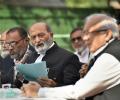
Earlier, board's counsel Zafaryab Jilani had said that he is not satisfied with the verdict.
The outfit also refused to comment on the rejection by the Muslim Law Board of Kanchi seer's proposals to resolve the Ayodhya issue.
Terming the Right to Education Act as an "attack" on the sovereignty of madarsas and other minority institutions, Islamic seminary Darul Uloom Deoband on Thursday said it will oppose it.

Sources in the prominent Muslim body Jamiat Ulama-i-Hind said it was not in favour of filing a review petition and wants the matter to end.
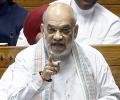
The Lok Sabha passed the Waqf (Amendment) Bill, 2025, with the ruling NDA defending it as beneficial for minorities while the opposition called it "anti-Muslim". All amendments moved by the opposition were rejected and the bill was passed with 288 votes in favor and 232 against. Union Minorities Affairs Minister Kiren Rijiju asserted that India is the safest place in the world for minorities, refuting claims of their insecurity.
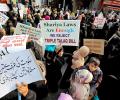
The application has been filed to oppose a batch of petitions on which the apex court had in 2018 issued notices to the Centre and other stakeholders while referring the matter to a 5-judge Constitution bench.

In a major crackdown, police arrested 39 people, including local cleric Tauqeer Raza Khan, in connection with the violence during the 'I love Muhammad' campaign after Friday prayers in Bareilly, while authorities suspended internet service in the district for 48 hours beginning Saturday.

The CBI court had on September 30, 2020 acquitted the accused including former deputy prime minister L K Advani in the case after which two Ayodhya residents -- Haji Mahboob and Syed Akhlaq -- moved a revision petition before the Allahabad high court.
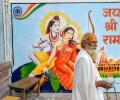
'If better sense prevails, Muslims should offer the disputed land in Ayodhya back to the government.'
"There have been regular complaints of illegal encroachment and sale of Wakf properties the country wide. Hence, we tried to amend some provisions of the existing Wakf Act 1995. Now questions are being raised as why Wakf properties is being registered. This is an age in which even births and deaths are being registered. I fail to understand why should there be any objection to registration of Wakf properties," Khurshid said in New Delhi.
'Pro-incumbency worked big time for the ruling party.' 'It has never happened in the past of pro-incumbency working so much for the ruling party.'

The All India Muslim Personal Law Board said that it would ask Qazis to tell bridegroom at the time of execution of 'nikahnama' that they would not resort to "three divorces in one sitting" as it was an "undesirable practice in Shariat".
'We are aggrieved about the ruling and there is no other way of putting it across to the Supreme Court and entire society that wrong has been committed and which requires correction.'
Congress MP Mohammad Jawed and AIMIM president Asaduddin Owaisi have challenged the validity of the Waqf (Amendment) Bill, 2025 in the Supreme Court, arguing that it violates constitutional provisions. The petitions claim the bill imposes arbitrary restrictions on Waqf properties and their management, undermining the religious autonomy of the Muslim community. They also allege that the bill discriminates against Muslims by imposing restrictions not present in the governance of other religious endowments. The bill was passed in the Rajya Sabha and Lok Sabha, with the petitioners arguing that it introduces limitations on the creation of Waqfs based on the duration of one's religious practice, mandates inclusion of non-Muslim members in Waqf administrative bodies, and shifts key administrative functions to government officials, thereby diluting the autonomy of Waqf management.
The Supreme Court of India has reserved its interim orders on three key issues related to the Waqf (Amendment) Act, 2025, including the power to denotify waqf properties, the composition of waqf boards, and the provision regarding government land. The court heard arguments from both the petitioners, who challenged the validity of the amended law, and the Centre, which defended the Act as a secular concept. The petitioners sought interim orders to prevent the implementation of certain provisions while the court considers the legal challenges.
Even as the nation awaits -- with bated breath -- September 24, when the Ram Janambhoomi-Babri Masjid verdict is to be delivered by the Lucknow bench of the Allahabad high court, a section of people who have been diligently following the issue are apprehensive about a further delay

Holding the AIMPLB responsible for the present state of affairs, Amber said the board never bothered to take (the issue of) triple talaq seriously, and now it was too late.

The Union law ministry will file a consolidated reply on the issue in the apex court by the end of this month.

The apex court had on March 30 observed that practices of 'triple talaq', 'nikah halala' and polygamy among Muslims were important issues involving "sentiments" and a Constitution bench would hear the pleas challenging these from May 11.
Alarmed by a petition pointing out a parallel Islamic judiciary for handling "Imrana" type cases, the Supreme Court on Tuesday issued notices to the central government, All India Muslim Personal Law Board and Islamic seminary Darul Uloom.
A five-judge bench headed by Chief Justice J S Khehar said it would look into the aspect whether triple talaq is part of an "enforceable" fundamental right to practice religion by Muslims.
"It (mosque) should be built where it is required....It is not required in Ayodhya where people are already worshipping...," the seer told NDTV 24X7.
